



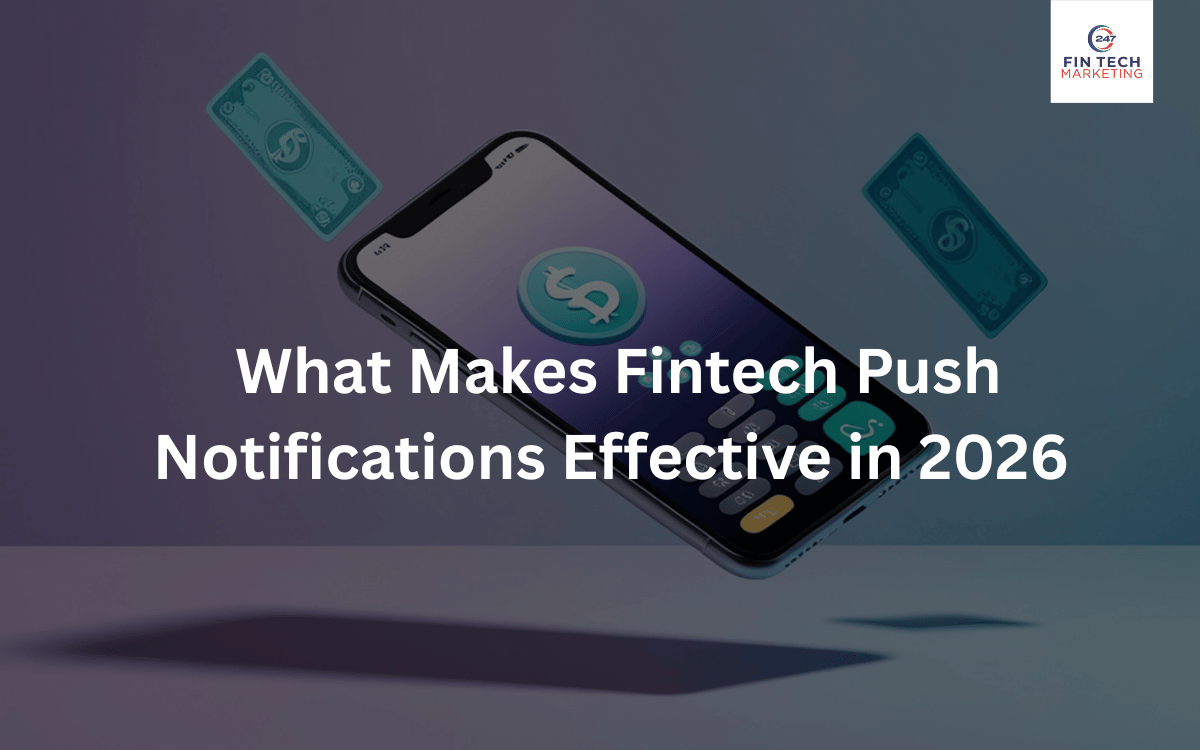
Push notifications have become one of the most powerful engagement channels for fintech companies. Whether you’re running a banking app, digital wallet, lending platform, investment app, or payment solution, notifications can drive transactions, improve retention, and strengthen customer relationships. However, fintech is fundamentally different from ecommerce, gaming, or social media.
In ecommerce, a poorly timed notification might annoy a user. In fintech, it can damage trust. When users allow a financial app to send notifications, they’re giving access to highly personal financial moments payments, balances, investments, loans, and security alerts. Every notification therefore becomes a trust transaction.
Effective Fintech Marketing Services relies on delivering the right message at the right time. A well-crafted notification reassures users, delivers value, and strengthens engagement. A poorly designed one can trigger opt-outs, app uninstalls, support complaints, or even regulatory concerns. As competition in fintech continues to intensify in 2026, the most successful companies will not be the ones sending the most notifications. They will be the ones sending the most relevant notifications.
The Biggest Mistake Fintech Apps Make
One of the most common mistakes fintech companies make is prioritizing urgency over trust. Many teams treat push notifications as a growth channel first and a customer experience channel second. As a result, users receive constant promotional messages:
- Apply for a loan today
- Get instant cashback
- Limited-time credit card offers
- Refer friends and earn rewards
While these campaigns may generate short-term conversions, excessive promotional messaging often leads to declining engagement over time.
Users begin to associate notifications with marketing rather than value. The problem becomes even more severe when urgency-based language is overused:
- Act now!
- Offer expires today!
- Last chance!
- Don’t miss out!
When every message feels urgent, users stop paying attention.
In fintech, trust is earned slowly and lost quickly. The goal is not to maximize notification volume but to maximize notification relevance.
The Trust vs. Urgency Framework
A practical way to evaluate fintech push notifications is through a Trust vs. Urgency framework.
Trust Level | Urgency Level | Recommended Action |
High Trust | High Urgency | Send immediately |
High Trust | Low Urgency | Send strategically |
Low Trust | High Urgency | Use cautiously |
Low Trust | Low Urgency | Avoid or minimize |
High Trust + High Urgency
These are the most valuable notifications.
Examples:
- Suspicious login detected
- Large transaction completed
- Failed payment alert
- Password changed
Users expect these notifications and often rely on them.
High Trust + Low Urgency
These notifications provide value without requiring immediate action.
Examples:
- Monthly Summary
- Investment portfolio update
- Savings milestone achieved
These messages strengthen engagement when delivered thoughtfully.
Low Trust + High Urgency
This is where many fintech apps make mistakes.
Examples:
- Apply now before offer ends
- Limited-time loan opportunity
These messages create pressure but often provide limited customer value.
Low Trust + Low Urgency
Examples include generic promotions, repetitive referral campaigns, or irrelevant feature announcements. These notifications contribute directly to notification fatigue and should be minimized.
Types of Fintech Push Notifications
Not all notifications serve the same purpose. The best fintech push notification strategy balances multiple notification categories.
1. Transactional Notifications
Transactional notifications confirm important account activities.
Examples include:
- Payment confirmations
- Money transfer completions
- Deposit alerts
- Withdrawal confirmations
These notifications build confidence and transparency.
Users want immediate visibility into their financial activities, making transactional messages some of the highest-performing notifications in fintech.
2. Security Notifications
Security notifications protect users and reinforce trust.
Examples:
- New device login detected
- Password changed
- Two-factor authentication alerts
- Suspicious activity warnings
These should always be prioritized and delivered in real time.
Missing a security alert can have significant consequences for both users and fintech providers.
3. Behavioral Nudges
Behavioral notifications help user’s complete important actions.
Examples:
- Bill payment reminders
- KYC completion reminders
- Low balance alerts
- Investment contribution reminders
The key is relevance. Behavioral nudges should help users achieve their goals rather than push company objectives.
4. Promotional Notifications
Promotional messages support growth and revenue initiatives.
Examples:
- Referral bonuses
- New feature launches
- Credit card offers
- Loan promotions
While useful, promotional notifications should be the least frequent category in most fintech apps. A healthy notification mix often contains significantly more transactional and behavioral notifications than promotional campaigns.
Personalization Strategies That Actually Work
Many fintech companies believe personalization means inserting a first name into a notification. Effective personalization goes much deeper.
Segment by User Lifecycle
New Users
Focus on onboarding and activation.
Examples:
- Complete KYC verification
- Add your first payment method
- Make your first transfer
Active Users
Help them build habits.
Examples:
- Spending insights
- Savings progress updates
- Investment reminders
Dormant Users
Re-engage carefully.
Examples:
- New feature announcements
- Account activity summaries
Personalized benefits reminders
High-Value Customers
Provide premium experiences.
Examples:
- Priority support updates
- Exclusive feature access
- Portfolio performance insights
At-Risk Users
Focus on retention.
Examples:
- Unfinished setup reminders
- Goal-based encouragement
- Personalized recommendations
Contextual Personalization
The most effective fintech notifications use behavioral and contextual data.
Consider:
- Transaction history
- Account balances
- Payment behavior
- Investment preferences
- Geographic location
- Device activity
Context creates relevance, and relevance drives engagement.
Notification Frequency Guidelines
One of the fastest ways to lose users is notification overload.
Even highly relevant messages can become annoying if sent too frequently.
Recommended Frequency Table
Notification Type | Recommended Frequency |
Security Alerts | Always when triggered |
Transactional Alerts | Always when triggered |
Behavioral Nudges | 1–3 per week |
Product Updates | 1–2 per month |
Promotional Campaigns | Maximum 1 per week |
These guidelines will vary based on user activity, but they provide a useful starting point.
Understanding Notification Fatigue
Notification fatigue occurs when users receive more messages than they perceive as valuable.
Common consequences include:
- Push notification opt-outs
- Reduced engagement
- Lower retention
- Increased app uninstalls
The cost of notification fatigue is often hidden because teams focus on click-through rates while ignoring long-term retention impacts.
A lower volume of highly relevant notifications usually outperforms a high volume of generic campaigns.
Compliance and Regulatory Considerations
Financial communication is heavily regulated compared to most industries.
Fintech companies must ensure notifications comply with applicable privacy, marketing, and consumer protection requirements. Key considerations include:
Marketing Consent
Users should clearly opt in to receive promotional communications.
Consent should be transparent and easy to manage.
Privacy Requirements
Notifications should avoid exposing sensitive financial information on locked screens whenever possible.
Careful message design helps protect user privacy.
Financial Communication Standards
Notifications must be accurate, non-deceptive, and appropriately disclosed.
Misleading offers can create compliance risks.
Never Disguise Promotions as Security Alerts
This is a critical best practice.
A promotional notification should never imitate a security warning to increase open rates.
Doing so can result in:
- User complaints
- Loss of trust
- Regulatory scrutiny
- App store policy violations
Trust should never be sacrificed for short-term engagement metrics.
AI and the Future of Fintech Push Notifications
Artificial intelligence is transforming how fintech companies approach customer engagement.
Rather than sending the same notification to everyone, AI enables highly personalized communication on a scale.
AI-Generated Notification Copy
AI can create multiple notification variations and identify the highest-performing messages for different audience segments.
Predictive Personalization
Machine learning models can anticipate user needs before they occur.
Examples include:
- Predicted low-balance warnings
- Personalized savings recommendations
- Investment contribution reminders
Send-Time Optimization
AI can determine when individual users are most likely to engage with notifications.
This improves visibility without increasing volume.
Behavioral Targeting
AI can identify patterns such as:
- Users likely to churn
- Users likely to convert
- Users likely to complete onboarding
This enables more relevant communication.
Dynamic Segmentation
Instead of relying on static customer groups, AI continuously updates segments based on real-time behavior.
Limitations of AI
Despite its advantages, AI is not a substitute for strategy.
Poor data quality, excessive automation, and irrelevant messaging can still damage trust.
Human oversight remains essential, particularly in financial services where accuracy and compliance are critical.
A 30-Day Fintech Push Notification Improvement Plan
Improving notifications does not require a complete rebuild.
Most teams can make meaningful improvements within 30 days.
Week 1: Existing Audit Notifications
Review every notification currently being sent.
Identify:
- Redundant messages
- Low-performing campaigns
- Overlapping notifications
- Excessive promotional content
Week 2: Implement Suppression Rules
Create controls to prevent notification overload.
Examples:
- Limit promotional sends
- Prevent duplicate alerts
- Pause campaigns after recent engagement
Week 3: Create Segmented Messaging
Build audience segments based on:
- Lifecycle stage
- Product usage
- Transaction behavior
- Risk level
Develop messaging specifically for each segment.
Week 4: Measure Results
Track performance improvements across key metrics.
Analyze:
- Engagement
- Retention
- Opt-outs
- Conversion performance
Use findings to refine future campaigns.
Metrics That Matter
- Many teams focus almost exclusively on click-through rate (CTR).
- While CTR is useful, it rarely tells the full story.
- The most important fintech notification metrics include:
Notification Opt-Out Rate
Measures whether users still want to hear from you.
A rising opt-out rate is often an early warning sign.
Retention Rate
Shows whether notifications contribute to long-term engagement.
Repeat Transaction Rate
Indicates whether users continue performing valuable actions within the app.
Conversion Rate
Measures successful completion of desired outcomes.
Click-Through Rate
Useful for optimization but should never be evaluated in isolation.
Support Tickets Related to Notifications
An often-overlooked indicator of customer frustration and confusion.
The healthiest notification programs optimize for customer trust and retention rather than clicks alone.
Conclusion
Just as effective Fintech SEO Services focus on delivering relevant content to the right audience, the future of fintech push notifications is not about sending more messages, it is about sending better messages. The strongest fintech push notification strategy is built on a simple principle: trust beats urgency. By prioritizing value, transparency, and user needs, fintech brands can foster stronger engagement and long-term customer loyalty.
When users trust your notifications, they engage with them. When notifications consistently provide value, retention improves naturally.
Remember:
- Relevance beats volume.
- Personalization beats generic messaging.
- Trust beats short-term conversions.
- Long-term retention matters more than temporary engagement spikes.
A leading Fintech Marketing Agency understands that improving financial app engagement in 2026 starts with a strategic review of every notification being sent. Evaluate whether each message genuinely helps the user, builds trust, or supports a meaningful action. The fintech companies that earn lasting customer loyalty won’t be the loudest. They’ll be the most relevant, most transparent, and most trusted.

Author
Mitesh Patel
Mitesh Patel is the co-founder of 247 FinTech Marketing, LawFirm Marketing and a columnist. He helps companies like Emerson and other top Fortune 500 compnies to grow their revenue.